B Reactor Museum AssociationAuthor: Michele S. Gerber, Ph.D., Facility Operations Division, Westinghouse Hanford Company, April 22, 1993 (approved for public release May 19, 1993)
To find a word in this glossary, just use your Web browser's Find (or Search) command. There is also a list of commonly used abbreviations at the end.
"2-S" Aluminum - Very pure, soft aluminum, used to make early reactor process tubes used at Hanford. By the early 1960s, this substance was known as #1100.
"63-S" Aluminum - An aluminum alloy containing small amounts of silicon and magnesium, used as cladding on the fuel elements during the early years of Hanford operations. By the early 1960s, this alloy was known as #6063.
"72-S" Aluminum - An aluminum alloy containing one percent zinc, used as cladding on the early reactor process tubes at Hanford.
94 Metal - Enriched uranium containing .947% U-235 by weight.
100 Areas - Areas along the Columbia River shoreline designated for reactor operations at the Hanford Site.
105 Buildings - Buildings that contained the reactors at the Hanford Site.
125 Metal - Enriched uranium containing 1.25% U-235 by weight.
210 Metal - Enriched uranium containing 2.10% U-235 by weight.
AEC - U.S. Atomic Energy Commission.
"B"-Material (also known as "B"-Metal) - A Hanford term for target fuel elements comprised mainly of bismuth with a small proportion of lead. B-Material was irradiated to produce polonium-210, the initiator in early atomic weapons. See also: Bismuth.
"C" Area - Charging area, located at the front, inside area of the reactor buildings, where fresh ("green") fuel rods were inserted into reactor process tubes.
"C" Operations - The act of charging or loading the reactors with fresh fuel.
"C"-Slugs (also known as "C"-Metal) - Fuel elements in which uranium was alloyed with aluminum. They contained 4.3% U-235 by weight.
"D" Area - Discharge area, located at the rear, inside area of the reactor buildings, where irradiated fuel rods were pushed or ejected from the reactor and stored in water-filled basins.
"D" Operations - The act of discharging or emptying irradiated fuel from reactor process tubes.
e (exponential) - The base of natural logarithm, having a numerical value of 2.71828.
"E"-Slugs (Eisenhower Slugs, Ike Slugs or "E"-Metal) - Fuel elements enriched to 1.75 U-235 by weight.
"H" Bomb - See Hydrogen Bomb.
HCRs - Horizontal Control Rods - Elements of control consisting of long cylindrical or rectangular aluminum shells containing boron or cadmium, as well as cooling passages for carrying water into and out of the rods. Each Hanford reactor was designed with a particular number that could be inserted into and/or withdrawn from the reactor to control reactivity on an everyday basis. See also: Shim Rods.
I&E Slugs (Internally and Externally Cooled) - Fuel elements that had single, complete holes through the middle so that cooling water could flow both through the core and the annulus for internal as well as external cooling.
IPD - Irradiation Processing Department. The designated name for the reactor operations and fuel fabrication divisions at the Hanford Site during the years that the General Electric Company served as the prime contractor, 1946-1965.
"J"-Slugs (also known as "J"-Metal or "Oralloy") - Fuel elements in which uranium was alloyed with aluminum. They contained 7.5% U-235 by weight, (but 93.5% of the uranium content was U-235).
LOE (Level Operating Efficiency) - A measure of reactor productivity calculated by comparing the actual portion of operations that were conducted at full power levels with the portion of operations that were conducted at less than full power levels due to startups, reactivity transients, poor flattening efficiency, and other factors that temporarily lowered power levels. In other words, a measure of non-equilibrium losses. See: Non-Equilibrium Losses.
MEV - One million electron volts.
MPP - Micro Pilot Plant - See WPP.
MRAD - Milli-rad - 1/1000 RAD - The rad is the unit of absorbed dose and is 100 ergs per gram. One millirad (1 mrad) is one-thousandth of one rad. The absorbed dose of any ionizing radiation is the amount of energy imparted to matter by ionizing particles per unit mass of irradiated material at the place of interest, expressed in rads. See also: RAD.
MREM - Milli-rem - 1/1000 REM. See also: REM.
MREP - Milli-rep - 1/1000 REP. See also: REP.
MW - Megawatt, or 1,000,000 watts.
MWD - Megawatt-Day - A unit of production or exposure equivalent to 1,000,000 watts of thermal power for a 24-hour period.
MWD/T - Unit of exposure per ton of fuel material.
"P" Department - Production Department. The earliest designation for the reactor operations and fuel fabrication divisions at the Hanford Site.
"P" Material - A Hanford term for reactor poisons (neutron absorbing materials).
"P" Push - A Hanford term for the discharge of poison columns from the reactors.
PCCF (Poison Column Control Facility) - An operational "C-D" facility for increasing flexible control of a reactor. It consisted of a limited number of selected process tubes with ball-valves inserted in the nozzles so that poison material could be charged or discharged during operation of the reactor. See also: Operational "C-D".
pH - A measure of the acidity or alkalinity of a solution, defined as the logarithm of the reciprocal of the hydrogen ion concentration in a given solution. For instance, if a given solution contains 1 x 10¹⁰ moles per liter of hydrogen ion, its pH is 10. See also: Molarity.
"Q"-Slugs (Also known as "Q"-metal or "10-66" material) - A Hanford term for thorium fuel targets tested in the mid-1950's for the production of U-233.
"R" Distance - A U.S. Atomic Energy Commission term representing the radius of a circle considered to encompass the hazard zone around an operating reactor. Calculated (in miles) by finding 0.01 times the square root of the reactor power level in kilowatts.
RAD - The unit of absorbed radiation dose equal to 100 ergs per gram.
REDOX Process - Reduction-Oxidation - A continuous action, solvent extraction, chemical process developed at Hanford in the late 1940's for the separation of plutonium from irradiated fuel rods. The REDOX Plant opened in January 1952, based on a methyl isobutyl ketone ("hexone") chemistry.
REM - A measure of absorbed ionizing radiation equal to the energy imparted to a biological system (cell, tissue, or organ) per gram of living matter of one rad of X-radiation. Acronym for Roentgen Equivalent Man. See also: Roentgen.
REP - An early (obsolete) term with the same meaning as the presently used REM. The acronym stood for Roentgen Equivalent Physical. See also: REM.
SCRAM - Safety Control Rod Ax Man - Derived as an acronym from the fact that the control rods in the first critical pile at Stagg Field at the University of Chicago were suspended by a rope. In case of need, the rope was to have been cut with an ax to lower the rods into the pile. In general use, the term referred to the sudden shutting down of a reactor, usually by dropping of safety rods. At Hanford, a No. 1 scram was the insertion of both HCRs and VSRs simultaneously as rapidly as possible. A No. 2 scram was accomplished by inserting only the HCRs as rapidly as possible.
SWPs - Acronym derived from Special Work Permits. Referred to job control specifications that concerned lengths of time and conditions of exposure to radioactive materials. The term later was applied by Hanford workers to clothing, procedures, and general conditions associated with work in radiation zones.
TAI Limit (Trip After Instability Limit) - At Hanford, a bulk exit water temperature limitation that specified that reactor operations could be conducted such that nucleate boiling, but not bulk boiling, was allowed in coolant water in the effluent piping system. The TAI limit was established at Hanford in 1958.
TBP Process - Tri-butyl Phosphate Process - A continuous action, solvent extraction chemical process developed at Hanford and first used in 1952 to separate uranium from high level waste. Beginning in 1955, the TBP process also was used as the basis for chemical extraction operations at the PUREX Plant.
TOA Limit (Top-of-Annulus Limit) - A tube temperature limit based on corrosion considerations at the top of the process tube.
TOE (Time Operated Efficiency) - A measure of reactor productivity which was calculated as the total hours operated during a month divided by the total number of hours in the month x 100. In other words, a measure of the amount of time a reactor was operating rather than shut down.
VSRs (Vertical Safety Rods) - Boron-containing rods suspended over open channels in the reactor during operation, so arranged that when the safety circuit was tripped, the rods would fall into the reactor by gravity and dramatically lower or shut down reactivity levels. Not used for standard control, but as the secondary safety system.
WPP - Water Treatment Pilot Plant (also sometimes called the MPP - Micro Pilot Plant) - Experimental facility built in the 1706-KE Building in 1962, in order to run trials in cooling actual and mocked-up reactor tubes with deionized, recirculating water. Later experiments expanded into other types of water, corrosion and film build-up studies.
X-Levels - Access areas to the Hanford reactor test holes. Located on the right for "far" sides of the reactors, level X0 was on the main floor of the 105 Buildings, level X1 was 15 feet above X0, and level X2 was 15 feet above X1.
Absolute Filters (also called High Efficiency Particulate Air - HEPA - filters) - Filters designed to trap 99.97% of airborne particulates (sized .3 microns or more) contacted by them.
Activated Silica - Sodium silicate (SiO2) prepared by the addition of sulfuric acid (H2SO4).
Activation - The process by which a substance becomes artificially radioactive through neutron bombardment.
Active Tube - A reactor process tube that contained a charge of fissionable material.
Active Zone or Region - That part of the reactor that contained the fuel, bounded by the ends of the uranium columns (front and rear) and by planes one-half lattice unit beyond the row and column centerlines (top, bottom, near, and far).
Activity - The radioactive intensity of a radioactive material, often expressed in terms of observable effects such as counts per minute or roentgens per hour at one meter.
Administrative Power Limit - The highest power level authorized and allowed for each Hanford reactor by the U.S. Atomic Energy Commission.
Adsorption - The taking up of one substance at the surface of another, as differentiated from absorption, which is the penetration of a substance into the body of another.
Aiming Tube - A chute attached to the rear faces of the Hanford reactors during the first year of operations, and used to guide the fall of irradiated fuel elements into the storage basins during discharge operations.
Alloy - A metallurgical combination of two or more materials, usually produced through fusing or melting.
Alpha Emitter - A radionuclide that undergoes transformation by alpha-particle emission.
Alum - Aluminum sulfate (sometimes known in the reference time period as "paper maker's alum").
Aluminum - Al - An element used in early Hanford reactor process tubes and fuel element cladding, due to its low neutron absorption capacity. The metal is white and oxidizes quickly, thereby forming an oxide film that strongly resists further oxidation in air. It is second in the scale of malleability, sixth in ductility and is a good conductor of electricity.
Anion - A negatively charged ion. Used in reactors as part of a demineralization system.
Annunciator - A common industrial device (panel) that audibly and visibly signaled that a preset trip point had been reached on any of several pieces of equipment or sensing devices used in early Hanford reactors, such as an outlet tube temperature limit, an HCR pressure limit, a safety circuit opening, etc. Annunciators also were used in other Hanford areas and in many other industries.
Anodize - To coat a metallic surface electrolytically with a protective oxide. The thickness or amount of anodization is measured in amperes per foot.
Anthrafilt - Anthracite coal ground into a granular material and used as a filter media in the 183 Filter Plants at Hanford.
Area Monitoring - The routine monitoring of the level of radiation or radioactive contamination of any particular area.
Argon - Ar - An element that is a gaseous constituent of air (0.94%) and was used as an air "detector" in reactor atmospheres. It also is used in electric light bulbs and fluorescent tubes.
Argonne National Laboratory - An Atomic Energy Commission site near Chicago, Illinois. Now supervised by the Department of Energy.
Atom - The smallest particle of an element which can take part in a chemical reaction. The atom has a heavy nucleus, consisting of protons and neutrons, while electrons rotate about it in orbits. The word is from the Greek and means "an uncuttable thing".
Atomic Energy - Early term for nuclear energy. It was energy released in nuclear reactions, such as when a neutron splits an atom's nucleus into smaller pieces (fission) or when two nuclei are joined together at hundreds of millions of degrees of heat (fusion).
Attenuation - The reduction in the intensity of radiation as it passes through matter, caused by a combination of scattering and absorption.
Axial Flattening - A Hanford term for achieving more uniform flux distribution within reactors, measured front to rear. See also: Flattening.
Back-seat - Verb - To move the material (charge) in a reactor process tube toward the upstream (or front face) end of the tube.
Backup Water - Any water that could be used for cooling a system in the event of failure of the normal cooling supply.
Baffle - A projection (horizontal or vertical) welded onto reactor downcomers or effluent basins to guide or diffuse the exiting coolant flow in order to decrease the avarage velocity and thus decrease vibration in piping and other system components.
Ball 3X, or Ball Safety System - The third or last ditch safety system that, when activated, would drop boron-steel and steel balls into the vertical safety channels of the Hanford reactors from hoppers mounted at or near the top of the channels. This system was used only if the other two safety shutdown systems failed.
Basin - (Storage Basin) - A large, swimming pool-like storage area, filled with water, in which radioactive materials, such as irradiated fuel elements, were kept. The water acted as a shielding material.
Beam - An unidirectional or approximately unidirectional flow of electro-magnetic radiation or of particles. A "column" of radiation.
Beta Particles - Small electrically charged particles thrown off by many radioactive materials at high speeds. They are identical with electrons, and possess small negative electric charges.
Binding - A condition of tightness that occurred between the reactor process tubes and the gunbarrels, or between the gunbarrels and the reactor shields and graphite, usually caused by expansion of the graphite and/or bowing of the process tubes.
Biological Shield - Shield consisting of concrete or iron and masonite laminations, built around Hanford reactors to reduce the radiation level to one that was tolerable to personnel. The biological shields surrounded the thermal shields on Hanford's reactors.
Bismuth - Bi - A metal that, when irradiated, could be separated to produce polonium-210. Polonium-210, an alpha-emitter, could be combined with a light element such as beryllium or boron to make a source of neutrons. Sometimes known at Hanford as B-Metal.
Boiling Disease - A Hanford term for a situation wherein steam formed in process tubes. Header pressures sufficient to sweep this steam from the tubes were needed and were maintained in Process Specifications.
Bombardment - The process of shooting neutrons, alpha particles and other high energy particles at atomic nuclei, usually in an attempt to split the nucleus or to form a new element.
Bore Blocks - See Tube Bearing Blocks.
Boron - B - Used in many early instruments for detecting and measuring neutrons because the isotope B10, which has a relative abundance of 18.8% in natural boron, breaks into two charged particles (He4 and Li7) when it absorbs a neutron. These charged particles were readily detectable. Also, because of its high neutron absorption capacity, boron and boron-steel was used in the control devices of nuclear reactors. It also was used as a constituent of neutron shields because relatively few, weak gamma rays are emitted when boron captures a neutron.
Bottom Shield - The bottom shield in Hanford reactors consisted of two layers of concrete. A layer of serpentine concrete 17 inches thick was nearest the core, and 96 inches of structural concrete was below the serpentine layer. The serpentine concrete could withstand temperatures of 100°C.
Bowing - Noun - The bending or distorting of reactor process tubes, usually caused by graphite expansion or contraction.
Bowing - Verb - A Hanford term signifying the redistribution of flux within reactors by using uranium charges of shorter lengths in the central zones.
Bromine - Br - A member of the halogen group of elements. The radioactive isotope bromine-87 played an important part in early reactor control.
Buckling - A term used to describe neutron leakage from one lattice cell to the next, and so called because it was a measure of the bending of the neutron flux, or curvature of the flux distribution at any point in a reactor. A "flat" zone had zero buckling, a highly poisoned "dished" zone (concave) had negative buckling, and a region with a convex curvature such as a reactive fringe or a critical size reactor had a positive buckling.
Bulk Outlet Temperature (or Bulk Exit Temperature) - The temperature of the effluent water leaving the reactor process tubes and entering the effluent piping systems.
Bulk Outlet Temperature Limitation - An administrative power level limitation imposed by the U.S. Atomic Energy Commission and based on a maximum allowable temperature that could be reached in bulk outlet coolant. In 1962, bulk outlet temperature limitation replaced power level as the limiting factor in Hanford reactor operations.
Bumper Fuel Element (or Bumper Slug) - A fuel element on which "bumpers" (fin-like projections) were welded, allowing freer water flow through ribbed process tubes to prevent hot spots and ruptures. See also: Self-Supported Fuel Element.
Burial Gardens (or Burial Grounds) - Areas designated for the underground disposal of solid radioactive wastes.
Burning Grounds - Areas designated for the open air incineration of trash not contaminated with radioactivity.
Cadmium - Cd - An element important in early reactor control devices, and used in special shields because of its very high capture cross-section for neutrons with energies of less than 0.5 electron volt. It occurs in the rare mineral greenockite but was obtained practically as a low-quality by-product from ores of zinc.
Camp Hanford - An Army anti-aircraft defense facility established to protect the Hanford Site from enemy bombing in 1950. Having a main base at North Richland and 16 forward positions (gun batteries) around the Hanford Site, Camp Hanford later consolidated into five Nike missile sites and operated until it was deactivated in 1961.
Can Closure - The process of obtaining a watertight seal or weld on the jackets of uranium fuel elements. Various techniques were tried at Hanford for effective can closure, including fusion welding, point pressure welding, and others.
Can - Cladding or jacketing around uranium fuel elements. The earliest cans used at Hanford were made of aluminum alloys, and the later cans were made of zirconium alloys.
Carbon - C - An element characteristic of organic matter, carbon is widely distributed in nature, occurring free as diamond and graphite. At Hanford, purified carbon was a key constituent of reactor graphite.
Cation - A positively charge ion; the sodium ion of sodium chloride. Used in reactors as part of a demineralization system.
Cavitation - A condition in which unstable vapor bubbles in a liquid, formed at or near critical flow, recondense or collapse, releasing energy and eroding or cavitating the containers (pigtail, nozzle, etc.). Pressure from the collapsing bubbles acted to cause tiny implosions that eventually formed holes and corroded the piping or containers.
Central Zone - See Control Zone.
Channeling - The phenomenon in which reactor effluent tended to remain as a distinct stream unit for several miles after discharge into the Columbia River.
Charge - Noun - The fissionable material or fuel placed in a reactor (or process tube) to produce a chain reaction.
Charge - Verb - To place fissionable material into reactors. See also: "C" Operations.
Charge Elevator - Movable platform at the front face of each reactor, containing hoists, platforms, rails, buckets and other equipment necessary to perform "C" operations.
Charge Platform - That part of the charge elevator where workmen would stand and "C" equipment would be mounted. See also: Charge Elevator.
Chattering - The phenomenon that occurred when fuel elements moved rapidly up and down in the process tubes, under the force of the flowing process water. Chattering occurred most often with shorter, lighter-weight slugs.
Check Valves - Valves that permitted only the in-flow, but not the back-flow, of process water through the reactors. Generally designed with a counter-weighted flap as the sealing element.
Cladding - Covering one metal with another, particularly the fuel elements for a reactor, to prevent escape of fission products. Also known as jacketing or "canning".
Clam-Shells - A Hanford term for the 1940's pneumatic charge-discharge machines used at the Site's reactors.
Coagulation - The process of suspended solids within a liquid clumping or congealing together to form a semi-solid mass.
Cocking - The phenomenon of fuel elements becoming uplifted on one side or on the upstream end within the process tubes.
Cocooned - Having a number of sub-compartments with a larger compartment. At Hanford, the term cocooned process hoods referred to shielded hoods or caves that contained several sub-compartments for holding small samples.
Cold Purge (also known as a Down Purge) - A purging operation performed while a reactor was shut down.
Cold Slugs - Unirradiated or "green" fuel elements.
Cold Startup - Any attempted startup while the reactor reactivity was not decreasing. The term usually referred to startup after a reactor was shutdown, and not following a temporary power level drop.
Cone Valve - Special carbon steel, cone type, plug valves used in the primary coolant system to provide leak-tight isolation service. This type valve was used in some "in-line" locations where the leak-tight stipulation was relaxed, although leakage was to be maintained at a minimum. The basic design was that of a plug cock, wherein a conical shaped plug was rotated within a tapered tube by an attached mechanism that first lifted and unseated the plug, then rotated it 90 degrees to open or close the valve, and finally lowered and reseated the plug into the valve body. No sealing lubricant was required.
Confinement - A system provided to protect the reactor plant environs from unacceptably high levels of radioactive contamination under non-catastrophic combinations of reactor misoperation and equipment failure. Confinement did not provide a continuous pressure shell around the reactor as containment would have done. Instead, confinement at Hanford utilized positive air flow from the vicinity of the reactor through particulate entrapment filters and halogen absorption filters, and with fog spray provided at the discharge face of the reactor.
Containment - Complete encapsulation of a reactor system with a pressurized shell.
Control Rods - Rods of neutron-absorbing material (cadmium, boron steel, or hafnium) used in reactors to control the chain reaction to a steady level by changing the effective multiplication constant and hence the reaction rate's time derivative.
Control Zone (also known as the Central Zone) - An area of approximately 173,000 acres located just north of the old White Bluffs townsite and the 100-H Reactor, on the north side of the Columbia River. Established in 1943 as a buffer zone to contain airborne fission products from the Hanford plants, the control zone was released to the Washington State Department of Natural Resources and the U.S. Fish and Wildlife Service for wildlife and recreational uses in 1971.
Conversion Ratio - Ratio of atoms of product formed per atom of U235 destroyed. Sometimes referred to as grams of product formed per megawatt day. See also: Goal Exposure.
Coolant - A substance, ordinarily fluid, used for cooling any part of a reactor in which heat was generated. Such parts included not only the core but also the reflector, shield, and other elements that became heated by the absorption of radiation.
Co-product - At Hanford, the production of tritium in a reactor whose primary product was plutonium. A more general interpretation would include any isotope produced in the same reactor as the major product, but not including by-products such as gratuitous neptunium.
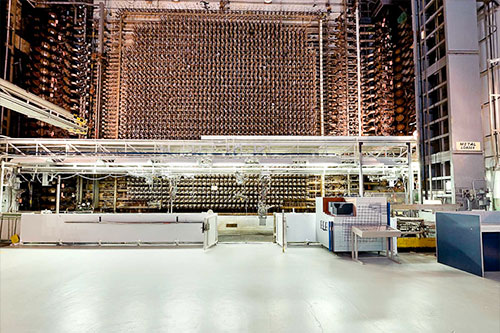
Core - The graphite stack or rectangle that comprised the center of a nuclear reactor.
Cored Fuel Elements - Uranium fuel elements having a 3/8-inch diameter central hole, with aluminum supports on either end. Experimentation with this type of fuel element occurred at Hanford from 1954-1957.
Corrosion - The slow wearing away of solids, especially metals, by chemical attack.
Corrosion Barnacles - Layers or ledges of corrosion product buildup on the external surfaces of metals. See also: Ledge Corrosion.
Corrosion Fatigue - The phenomenon of the failure of metals when subjected to repeated cycles of corrosive attack.
Cosine Curve - A relatively symmetrical curve expressing, in the Hanford reactors, a front to rear energy level distribution that peaked in the center and fell off sharply at the approach to both faces.
Counter (Crystal) - A radiation detection instrument which employed solid crystals such as silver chloride or thallium bromide.
Counting Rate Meter - A device that gave a continuous indication of the average rate of ionizing events. When plotted, the slope could be interpreted over time.
Crib (sometimes called an "Earth Reservoir") - A Hanford term for earth basins located near the reactor retention basins for the disposal of liquids having higher than acceptable levels of radioactivity. Cribs acted as seepage pits to filter and hold radioactive particulates, and also provided time delay for radioactive liquids.
Critical - The condition existing when the effective multiplication constant for a reactor is exactly unity (or 1) so that a self-supporting fission chain reaction can be maintained.
Cross-Sectional Sampling - At Hanford, a pattern of sampling Columbia River water at several real points distributed both vertically and horizontally throughout a stretch of water.
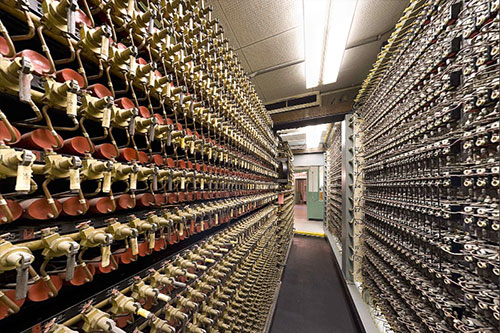
Crossheaders - Pipes smaller than the "headers," that carried inlet water from the risers to individual process tubes, and outlet water from the process tubes to the exit risers.
Crossover Lines (or Crossover Piping) - Pipes that routed effluent from the top of exit risers into the reactor downcomers.
Crossunder Lines (or Crossunder Piping) - Drain lines connecting the bottom of the rear risers to the downcomers.
Curie - A unit of radioactivity equal to 3.7 x 10¹⁰ disintegrations per second. It is approximately equivalent to the activity of 1 gram of radium.
Current Dissipators - Construction equipment consisting of large sections of interlocking sheet piling embedded in a concrete footing. At Hanford, used to divert the current of the Columbia River during the installation of in-river outfall piping.
Cushion Chambers - Cement enclosures lined with cypress planks at the bottom of the downcomers of early Hanford reactors.
Cylinder Piping - Steel piping having concrete on the inside and the outside of a pres-stressed steel sleeve.
Deactivation - The process of rendering a reactor (or other facility) inoperable and stable, so that manual attendance is not required on a constant basis.
Decay, Radioactive - (1) The decrease with time of the number of radioactive atoms in a sample, as a result of their spontaneous transformation. (2) A synonym for radioactive disintegration.
Decontamination - The act of removing radioactive surface contaminants from process equipment or structural materials by chemical or physical abrasion of the contaminated surface.
Deionization - The process of creating an electrically neutral atomic or molecular configuration by removing excess electrons (i.e., negatively charged ions). At Hanford, experimentation began in the early 1960's in deionizing reactor process water in order to reduce the buildup of activation corrosion products and films on internal components and on fuel elements.
Demineralized Water - Water which has had almost all dissolved and undissolved materials removed.
Demineralizer (or Ion Exchanger) - Equipment used to purify water by means of replacing impurity ions with water ions. In the cation units, the cations in the filtered water were exchanged for hydrogen ions. In the anion units, most of the anions were exchanged for hydroxyl ions. The product was called demineralized water.
Detector - An instrument used to monitor conditions in a system.
Diesel Oil - A light distillate fuel used in diesel engines in pumps and other equipment used in Hanford's 100 Areas.
Diffusion - The passage of particles through matter in such circumstances that the probability of scattering is large compared with that of leakage.
Dimpling - Verb - A Hanford term signifying the manipulation of poison patterns within the reactors so as to achieve higher and lower temperatures and exposures within specific process tubes and reactor zones.
Discharge Elevator - Movable platform at the rear face of each reactor, containing hoists, platforms, rails, casks, buckets, chutes and other equipment necessary to perform "D" operations.
Discharge Platform - That part of the discharge elevator where workmen could stand and equipment could be carried to attend to stuck fuel elements or other required rear face operations. See also: Discharge Elevator.
Down Purge - See Cold Purge.
Downcomers - Large conduits (or pipes) at the rear of the reactors through which the outlet water flowed horizontally and then downward toward the retention basins.
Downstream End - Referring to the region in the "back" end of a reactor process tube, or that portion further toward the discharge or rear face than toward the charge or front face of the reactor.
Downtime - The time during which a reactor was idle because of adjustment, replacement of tools, cleaning, reloading, or other maintenance. At Hanford, this term referred specifically to the time during which a reactor was shut down or subcritical.
Driver Elements (or Drivers) - Enriched uranium fuel elements used to boost reactivity in certain reactor zones or in certain types of unusual fuel elements placed nearby the drivers in reactors.
Dual Trip System - An automated instrumentation system requiring two independent electrical signals in order to shut down or scram a reactor.
Dummies - Non-fissionable, solid tubular, perforated tubular, and even poison and steel cylinders resembling fuel elements. Used to create spacing and neutron barriers within process tubes. See also: Perfs, Tubulars, Spacers, Expendables, and Non-Expendables.
Dummy Elevator - Machinery installed in the Hanford reactor buildings in 1960-1961 to transport non-expendable, dummy fuel elements to and from automated decontamination facilities.
Effective Bed Length - That portion of a physical barrier-type filter that was effective (i.e., operating, and not saturated) at any given time.
Effluent - At Hanford, the process water after having passed through a reactor. Used or spent cooling water and chemicals that exited the Hanford reactors as waste.
Elbow (of the Downcomer) - That point where the piping through which effluent exited the reactor building turned 90° from a horizontal to a vertical flow.
Electrolysis (Electrolytic Conduction) - The conduction of electricity accompanied by the actual transfer of matter (migration of ions). External corrosion of process tubes was caused by electrolytic conduction between aluminum and graphite in a water solution.
Electrolyte - A substance that dissociates into ions in solution or when fused, thereby becoming electrically conducting.
Electroneutrality - The state wherein the number of negatively and positively charged ions within water or other solutions is in perfect balance.
Element - One of the basic kinds of matter (hydrogen, carbon, oxygen, uranium, etc.) from which all chemical compounds are formed. All the atoms of each element have the same atomic number. Each element is designated by a chemical symbol as shown in the table of elements and in the periodic chart. See also: Atom.
Emergency Backup Water - Reactor cooling water supply that was used in the event of a lack or failure of both the normal and secondary supplies.
Enriched Material - (1) Material in which the amount of one or more isotopes of a constituent has been increased. (2) Uranium in which the abundance of the U-235 isotope was increased above .7115%.
Enrichment - The addition of extra U-235 to natural uranium. Also, the charging of any material in a reactor that added more reactivity than natural uranium.
Entrainment - The condition wherein air or steam bubbles were trapped in reactor piping or process tubes, often causing water or steam surges or water hammer. The broader meaning of entrainment refers to the pick-up of various substances by water or air flow.
Equilibrium - The operation of a reactor in steady state; that is, the effective multiplication factor was unity and changed very slowly with time.
Equilibrium Losses - The difference between optimum or maximum allowable power levels and actual power levels attained during reactor operations.
Equilibrium Scrams - Automatic reactor shutdowns caused by instrumentation. See also: Instrument Scrams.
Excess Reactivity - The excess fuel above that needed for a reactor to go critical.
Exclusion Area - Designated area within a larger reactor area (100 Area) governed by special access requirements and barriers based on the presence of radioactive materials and potential hazards.
Excursion - A sudden, very rapid rise in the power level of a reactor caused by super-criticality.
Expendables - Dummies placed closest to the uranium fuel charges inside reactor process tubes. These dummies became so radioactive that they could not be re-used; hence the name "expendables." See also: Dummies.
Export Lines - Piping that brought raw river water to Hanford's 200 Areas from the 100 Areas. The water was then treated in 200 Area filtration plants, in order to become sanitary water.
Export Water System - See Export Lines.
Far Side - In the Hanford reactors, the right side as one faced the front of the piles. This side was opposite from that into which the HCRs were inserted.
Fast Neutrons - Neutrons having energies greater than that of intermediate neutrons; that is, energies exceeding 0.1 Mev.
Filtered Water - Water that had been chemically coagulated and filtered by the 183 Filter Plants in the reactor areas. Some water was filtered for service purposes, some for sanitary purposes, and some was filtered to become reactor process water. See also: Process Water.
Fissile - Capable of being split, or fissioned. Used to describe types of atoms such as plutonium, uranium, thorium, protoactinium and others which can undergo fission. See also: Fissionable.
Fission - A particular kind of disintegration of an atomic nucleus. In fission, the nucleus is stimulated by the capture of a neutron which strikes it. The nucleus becomes unstable, breaks into two main fragments and spills out several neutrons. The atomic nuclei produced as fragments and the several neutrons rush apart at high speed from the point where the fission occurred. The neutrons, being uncharged, move through solid matter, but the nuclear fragments are quickly brought to rest by colliding against other atoms of the material in which the fission occurred.
Fission Product - Atoms produced in the fission process, often by the splitting of the U-235 atom. Many fission products are radioactive and decay by emission of particles to form elements that are stable. Fission products are responsible for nearly all of the radioactivity emanating from "spent" (irradiated) fuel elements. The radioactive decay of fission products continues to produce a sizable amount of heat, even in a shut-down reactor.
Fissionable - Capable of being fissioned by the capture of a particle such as a neutron or a photon. A synonym of Fissile.
Fissionable Material - Those materials in which nuclear fission can result in a chain reaction with the emission of a large amount of energy, such as U-235, U-233, and Pu-239.
Flash - Noun - At Hanford, a sudden and temporary spike in radioactivity or chemical levels within a substance or the environment.
Flattening - Verb - The act of charging either enriched or poison material in specific patterns so as to achieve a more desirable (usually more uniform) tube power distribution within a reactor. See also: Axial Flattening and Radial Flattening.
Flocculation - The process of coagulation, or the clumping together of suspended solids within a liquid into a semi-solid mass. Usually caused by a chemical agent.
Flush-Charging - The type of charging that occurred in operational "C-D," when fuel elements were loaded into the process tubes while water was flowing through the tubes. The flow of that water was used to move the slugs down the tube length. This charging method was different than the "dry," or ram-type charging used in manual or shutdown "C-D."
Flux - (Neutron Flux) - A measurement of the density of neutron flow during critical periods. The product nv where n is the number of neutrons per cm3 and v is their mean velocity in cm/sec.
Fly-Eye Viewer - A device consisting of four wide-angle lenses, mounted on the discharge area wall opposite the rear faces of the Hanford reactors, and used to view portions of the discharge area.
Fog Spray System - Located within the rear or front face enclosures of a reactor building to produce, on demand, a finely divided spray of water to absorb a portion of the halogen vapors and settle out the airborne particulate matter released during fuel element fires. Also used for washing down rear or front face atmosphere, structures, etc.
Foil - A wire or a very thin sheet or strip of various metals, used to poison or enrich reactivity when attached or placed adjacent to fuel charges or experimental samples. Also used to measure induced radioactivity.
Fringe Tubes - Process tubes located furthest from the central zones of the reactors, and closest to the shields surrounding the reactor cores.
Front (or Front Face) - The face of a reactor through which the cooling water entered the process tubes.
Fuel (Nuclear Fuel) - A fissionable material of reasonably long life used or usable in producing energy in a nuclear reactor; i.e., capable of maintaining a self-sustaining chain reaction under the proper conditions.
Fuel Column - The lineup of fuel elements within a process tube, progressing from upstream to downstream end.
Fuel Element - The physical or mechanical form in which source and special nuclear material is incorporated into a reactor. At the Hanford reactors, uranium metal in short cylinders was encased in corrosion-resistant metals to form fuel elements. See also: Fuel Rod, Fuel Slug, Fuel Target, and Lag.
Fuel Rod - Fuel Element, Fuel Slug, Fuel Target, or Lag.
Fuel Rupture Monitor - A system to detect traces of fission products from defected fuel elements. In the early Hanford reactors, sample lines from rear crossheaders and risers flowed through beta ionization chambers. Scintillation-type gamma detectors replaced the beta chambers in the mid-1950's.
Fuel Slug - See Slug.
Fuel Target - Fuel Element, Fuel Rods, or Slug.
Galvanic - Of, or pertaining to, direct current electricity, especially when produced by chemicals. Galvanic corrosion in Hanford reactors occurred as the result of electrolytic action between water (from wet graphite) and aluminum process tubes and other metallic fittings and piping.
Gamma Energy - Energy derived from or produced by gamma rays.
Gamma Monitor - In the Hanford reactors, an instrument system that monitored a band of gamma energy emanating from effluent water. Each end of each rear crossheader and riser was monitored to detect fission product gamma activity.
Gamma Ray - A nonmaterial short-wave radiation emitted by some radioactive atoms. Similar to X-rays produced by high voltage X-ray tubes, gamma radiation resembles X-radiation and ordinary light in being related to electromagnetic waves, but differs from other atomic radiations in that it comes from the nucleus of the atom rather than from the electrons outside the nucleus which are the source of light and X-rays.
Gas Cylinders - Storage containers for helium, carbon dioxide, and other gases used in industrial operations.
Gas Plenum - An enclosure between the rear, side, front and top thermal and biological shields of Hanford's reactors, where the He and CO2 gases that comprised the reactor atmospheres were circulated and sampled.
Goal Exposure - The length of time (usually measured in megawatt/days) that uranium fuel charges were left in a reactor to reach a desired isotopic composition. "Higher" goal exposures referred to longer time periods. The conversion ratio, amount of uranium burn-up, and isotopic composition of the product varied with different goal exposures.
Graphite - Purified carbon produced from heated petroleum coke and coal-tar pitch. For reactor layup purposes, graphite was machined into block form.
Graphite Burnout - Oxidation of graphite, or loss of carbon atoms in gaseous form, so as actually to reduce the mass and strength of the solid graphite. See also: Graphite Transport and Oxidation (of Graphite).
Graphite Expansion - The swelling of graphite that occurred when the carbon atoms in the crystal lattice realigned themselves under the stress and heat of neutron bombardment.
Graphite Stringer Thermocouples - A means of measuring graphite temperatures in Hanford's reactors that was installed when the built-in graphite temperature monitoring thermocouples failed. A few selected process tubes were removed and replaced by a train of graphite cylinders that contained thermocouples.
Graphite Transport - See Graphite Burnout.
Graphitization - The process of heating a mixture of petroleum coke and coal-tar pitch to burn off impurities and blend the two materials into graphite. The usual temperature required for graphitization was 2500 °C.
Gravity Filters - Filters that operated by the natural, downward passage of water, rather than by pumping action.
Grid - A supply network of electrical power.
Grizzlies - A Hanford term for the large grates on the 1904 outfall piping that led from the reactors to the Columbia River. See also: Strainers.
Groove Corrosion - A type of corrosion on metallic surfaces identified by tiny, concave pits or grooves reaching from the surface into the central cores of the surfaces. See also: Pitting.
Gross Beta - A total measurement of the radioactivity level produced by the combined activity of all isotopes present in a given sample whose primary energies were emitted by beta particles or beta radiation.
Guillotine - Special tool developed and used at Hanford to chop lengths of process tubes and poison splines into short segments as they came out of the discharge face of the reactors.
Gunbarrel - A carbon-steel sleeve (pipe) extending through the shields into the graphite reflector of Hanford's reactors, through which the process tubes passed. A gunbarrel at each end of a process tube acted to transfer the weight of the thermal shields to the biological shields, and to protect the process tube channels. See also: Sleeve.
Half Life - The length of time it takes a sample of radioactive material to decrease to half of its original amount of radioactivity by spontaneous decay. The half life is a physical constant characteristic of the material, independent of external conditions such as temperature and pressure. In the first half life, the amount of material left unchanged is half the original amount; in the next half life interval, half the remaining amount, or one-fourth the original amount remains.
Halogens - Members of a group of five chemically related, non-metallic elements including fluorine, chlorine, bromine, iodine and astatine. Halogens can assume stable (elemental) or radioactive forms.
Hanford Engineer Works - Name for the Hanford Site from 1943-1946.
Hanford Works - Name for the Hanford Site from 1947-1973.
Hazard Area - A U.S. Atomic Energy Commission term referring to a circle considered to encompass the danger zone around an operating reactor, in the case of an incident involving the unplanned escape of radiation. See also: "R" Distance.
Head - The energy possessed per unit weight of a fluid, due to (1) its elevation above some point, (2) its velocity, (3) its pressure.
Header - A manifold that fed to, or accumulated from, more than one vessel or pipe.
Health Instruments (H.I.) Division (earlier, H.I. Section) - At Hanford, the group responsible for establishing radiation protection rules and standards, and for monitoring for personnel and environmental contamination from 1944 to 1965.
Heat Exchanger - Equipment for removing the heat from recirculating reactor process water, usually through steam venting.
Helium - He - A chemically inert gas, obtained by compression and fractionation of the gas from certain wells and from some radioactive materials. Helium has a very small neutron absorption cross section and a high heat transfer capacity.
Helium Leak Detection System - A system used to locate in-reactor process tube leaks by detecting an influx of the reactor's helium atmosphere within tubes subjected to a vacuum.
Hexavalent - A substance in the +6 valent state. See also: Valence.
Highly Enriched Uranium - Uranium having a U-235 isotopic weight percent of less than 93, but more than 75.
Horizontal Control Rods - See HCRs.
Hot - A slang term for materials that are radioactive, usually above the state found in nature due to exposure to radiation.
Hot Purge - A purge operation performed while a reactor was running.
Hot Spot - A surface area of higher than average radioactivity, on a fuel element or process tube. Also could refer to a localized area of very high activity and temperature within an entire reactor zone.
Hot Startup - Any startup attempted while the reactor reactivity was decreasing. The term usually referred to startup or significant power increases before a reactor had come to a full shutdown.
Hydraulic Dam - A below-ground mound in the groundwater table, caused by the disposal of liquid wastes to the soil at a rate faster than that which the groundwater could absorb. In the 1950's and 1960's at Hanford, it was postulated that such mounds could serve as barriers or "dams" to prevent or regulate the flow of groundwater plumes in specific directions.
Hydrogen Bomb (also known as the "H" Bomb or Super Bomb) - Thermonuclear weapon first developed and successfully tested by the United States in 1952. The operating mechanism was fusion, not fission as in the earliest atomic weapons. See also: Thermonuclear.
Idaho National Engineering Laboratory (INEL) - see Reactor Testing Station.
Ike Slugs - See "E" Slugs.
Induced Radioactivity - Radioactivity produced by nuclear reactions.
Influent - Treated cooling water and chemicals pumped into the inlet ends or "fronts" of the Hanford reactors.
Inhour (ih or IH) - An early term for measuring units of excess reactivity. One inhour was the amount of excess reactivity required for the reactor flux level to increase by a factor of e in one hour; two inhours' excess permits a factor of e increase in 1/2 hour, etc. See also: e.
Inland Lake - Artificial lake or reservoir proposed at Hanford in the 1950's and 1960's, for the purpose of holding reactor effluents for slow percolation through the soil to groundwater. The lakes were to be located near Gable Mountain, and were to serve as alternatives to the direct disposal of effluents in the Columbia River.
Inlet Temperature - The temperature of the cooling water as measured just before it entered the reactor process tubes.
Inner Rod Room (IRR) - Access room in the reactor buildings for reaching and servicing the HCRs. This room was closest to the HCRs themselves, and portions of the rods sometimes were withdrawn into this enclosure. Hence, the IRR was a radiation zone. See also: Outer Rod Room.
Instrument Scram - Automatic shutdown of a reactor, triggered when preset operating limits were "tripped" (i.e., exceeded or under run).
Iodine - I - A halogen, iodine occurs sparingly in the form of iodides in sea water, in Chileas Saltpeter, in brines from old sea deposits and in caliche. Iodine-135, a nuclide resulting from the fission of U-235, is the precursor of Xe-135, a large neutron absorber. The half life of this isotope (6.68 hrs.) strongly influenced the minimum down time of a Hanford reactor. Iodine-131, another fission product, was an isotope of primary biological concern in Hanford operations, due to its ability to destroy or inhibit thyroid function.
Ion - A charged atom or molecularly bound group of atoms; also can be a free electron.
Ion Exchanger - See Demineralizer.
Ionization - The process by which an atom that is ordinarily electrically neutral acquires an electrical charge. When electrical discharges occur, some of the atoms lose one or more of the outer electrons and are left with a net positive electric charge. Atoms can be ionized by absorption of light or absorption of X-rays or as a result of being struck by an electron. An atom thus ionized is called an ion.
Ionization Chamber - An instrument for measuring the amount of ionizing radioactivity produced in air or other gas. The quantity of electricity in the form of ions carried to chamber electrodes is measured. The ion current is a measure of the character and intensity of the radiations.
Ionizing Radiation - Electromagnetic (gamma, X-ray, etc.) or particulate (electron, proton, etc.) radiation produced by the passage of ions through matter.
Iron - Fe - The most abundantly produced metal, although aluminum occurs in more of the earth's crust. Iron, because of its relatively high mass, was used in radiation shielding to absorb gamma radiations, slow down fast neutrons by inelastic collisions, and absorb thermal neutrons. As a structural material, iron, in the form of steel, was used for process water piping, reactor containers, fittings, etc.
Irradiation - Exposure to radiation.
Isotopes - Forms of an element with slightly different weights but the same chemical properties. Atoms of a given element that have different numbers of neutrons in the nucleus therefore differ in mass or weight.
Jacketing - See Cladding.
Krypton - Kr - A noble or stable gas that occurs naturally as one part in a million parts of air. The fission product Kr-85 was a constituent of Hanford reactor exhaust.
Lag - Fuel Element, Fuel Rod, or Slug.
Last Ditch Safety System (Tertiary Coolant System) - Originally a boron solution held in tanks above the reactor, and replaced in the 1950's by hoppers filled with boron and steel balls, this system existed to drop neutron-absorbing poisons into the reactors in case the HCRs and VSRs failed to control the reactivity. See also: Ball 3X and Boron.
Last Ditch Coolant System (Tertiary System) - An emergency coolant system kept for use if the primary and secondary reactor coolant systems failed. The treated water was supplied from high tanks known as 1902 Structures.
Lattice - The pattern of process channel configurations in reactors, with respect to the distance between channels. Different lattice configurations affect the reactivity and capabilities of the reactors.
Layup - Verb - The process of stacking or arranging graphite blocks into a permanent pattern that formed the reactor core.
Lead - Pb - A bluish-white metal with a bright luster, very soft and malleable, ductile, and a poor conductor of electricity. In the nuclear field, lead often was used as a radiation shield because its high mass was effective in absorbing gamma radiation.
Leakage - (1) The loss of neutrons by diffusion because of incomplete reflection at the boundaries of a reactor core. (2) The escape of neutrons or radiation through a shield.
Ledge Corrosion - A type of corrosion on metallic surfaces identified by the overlapping build-up of layers of external corrosion product. See also: Corrosion Barnacles.
Lines - Pipes.
Masonite - A manufactured blend of ground wood, bark, cement brick, stone, and other substances, formed into a sheets of building material.
Metal Loaders - Attached to hoists and monorails at the front face of the Hanford reactors, these carriers hauled "C" tools and fresh uranium charges.
Micro - Prefix meaning one millionth.
Mil - One one-thousandth of an inch.
Minimum Downtime - The time required after shutdown for the reactor reactivity to pass through a minimum and increase to the extent that the reactor would become critical if the control rods were withdrawn. The reactivity transient or change was due primarily to buildup and decay of Xe-133.
Mining the Graphite - A Hanford term that referred to reaming and vacuuming out graphite dust and particles that had been loosened in tube replacements and other maintenance and repair efforts. Repeated minings were undesirable, as they weakened the mechanical strength of the graphite core. Mined samples, however, could be tested to measure stored energy levels, embrittlement, and oxidation of the graphite.
Mixer (or Mixer Charge) - A special attachment, spool-like in design, welded onto a normal I&E uranium fuel element, used to intermix the coolant flow streams in the hole and annulus and reduce any unbalance in temperature.
Moderator - Material used in a reactor for slowing down the average speed of a group of neutrons to thermal energies. In a moderator, a high scattering cross section implies frequent collisions between neutrons and the moderator; a low atomic mass results in a large average energy loss per collision. A good moderator had both of these characteristics so as to slow a neutron as rapidly as possible with a minimum number of collisions. Moderating materials used in early Hanford reactors included carbon (graphite) and water, both heavy and light.
Molarity - A measure of the strength or concentration of acids, measured in units called moles.
Monitoring - The continuous or periodic determination of the amount of ionizing radiation or radioactive contamination present in an occupied region, as a safety measure for purposes of health protection.
Myrnalloy Slugs - A Hanford term for thorium fuel elements in solid metallic form tried in the early 1950's as reactor poisons. Myrnalloys were not used as target elements.
Natural Uranium - Uranium with the following isotopic compositions: U-233, 0.006%; U-235, 0.712%; U-238, 99.280%.
Near Side - In the Hanford reactors, the left side as one faced the front of the piles. The side of the reactor through which the HCRs were inserted.
Neptunium - Np - Np-239 is the decay product of U-239 which is formed by radioactive neutron capture in U-238. The neptunium decays via beta emission to Pu-239, after a 2.3 day half-life.
Neutron - A particle with no electric charge, but with a mass approximately the same as that of the proton. In nature, neutrons are locked up in the nucleus of an atom, but they can be knocked out in various kinds of atom-smashing experiments. In free space they are unstable, decaying by beta emissions, but in matter they are usually absorbed before decay can occur. When a uranium atom undergoes fission through the capture of a neutron, several more neutrons are produced which continue the process by the mechanism of chain reaction.
Neutron Detection Facility - Located in the gas plenum at the rear of the early Hanford reactors, this set of flux monitors measured radiation leakage through the shielding.
Neutron Flux - In a reactor, neutron flux refers to the rate of flow of neutrons within the core. See also: Flux.
Neutron Leakage - The escape of neutrons through a barrier or opening, or by diffusion because of incomplete reflection at the boundaries of a reactor core. See also: Leakage.
Neutron Source - Any source that emits neutrons. A neutron source can be used in a nuclear reactor as a part of the startup procedure, or in a nuclear weapon as the initiator.
Nitrogen - N - Nitrogen makes up 78 percent of air by volume, and is obtained by liquefaction and fractional distillation of air. Nitrogen is colorless, odorless, and generally inert, yet when combined with other molecules is very active.
Noble Gases - Inactive or inert gases.
Non-Equilibrium Losses - The difference between actual production during reactor startups and the optimum or maximum attainable production that would have occurred if reactors returned instantaneously to pre-shutdown power levels.
Non-Expendables - Dummies that did not attain radioactivity levels high enough to be buried as waste. These dummies could be decontaminated and re-used; hence the name "non-expendables." See also: Dummies.
Noodle - A Hanford term for a plastic cylinder that was pushed through the reactor process tubes after "D" operations, to make sure that the tubes were empty of irradiated charges.
Nozzle Caps - Process tube closures, front and rear.
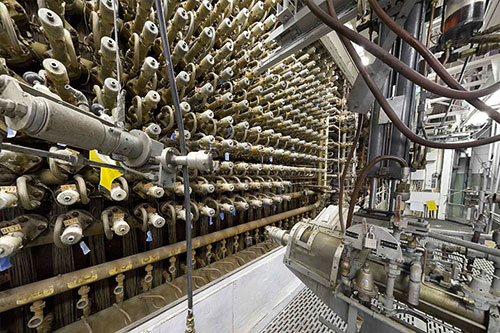
Nozzles - Stainless steel (later aluminum) adapters or fixtures at both ends of reactor process tubes, through which the cooling water and fuel elements entered and exited the process tubes.
Nuclear Energy - The energy released in a nuclear reaction, such as fission or fusion.
Nuclear Instrumentation - Systems that provided indications of neutron flux level, flux distribution, and the rate of change of neutron flux during reactor operation. They also monitored the reactor period and other aspects of reactor operations.
Nuclear Reaction - Result of the bombardment of a nucleus with sub-atomic particles or very high energy radiation. Possible reactions are emission of a particle different from the bombarding particle or the splitting of the nucleus (fission), decay of a radioactive material, or fusion.
Nucleate Boiling - Pre-bulk boiling. A condition in which a liquid starts evaporating at small projections of the heat transfer surface, forming small bubbles of vapor which detach themselves when they become big enough. The first stage of excitation reached in liquids as they approach their bulk boiling temperatures.
Oak Ridge Plant - A U.S. Atomic Energy Commission facility near Knoxville, Tennessee. Now supervised by the Department of Energy, this facility has been renamed the Oak Ridge Site.
Octant Monitor - A flux monitoring system of eight ion chambers located near the corners of the reactor and connected to meters in the control room.
Omega Seals - Thin, flexible carbon or stainless steel strips, welded over the horizontal joints between the tie straps which in turn were welded over the biological shield blocks of the Hanford reactors. The purpose of the omega seals was to form a gas seal for the biological shield.
Operational "C-D" - Charge-discharge operations performed while the reactor was operating (i.e., not shut down).
Oralloy (also known as "J"-Metal) - A Hanford term for the blend of uranium and aluminum enriched to 7-7.5 percent U-235 by weight. U-235 comprised 93.5% of the uranium content itself. See also: "J"-Metal.
Orifice - A metal disk with an opening of specific diameter which was inserted in the inlet nozzle or pigtail assembly so that the flow of inlet cooling water occurred at a controlled rate determined by the diameter of the orifice and by the pressure of the fluid. The flow could be determined by measuring the pressure on both sides of the orifice.
Orifice Pattern - The pattern of venturis and/or orifices used to establish flow rate zones in the reactor. The pattern usually was represented by zones on a temperature map form, and, at Hanford, consisted of a large central area of maximum flow tubes surrounded by one or more concentric zones of less flow per tube.
Outer Rod Room (ORR) - Enclosure in the reactor buildings where the HCR drive assemblies were located. The IRR was directly adjacent to the Inner Rod Room, but further away from the reactor core. See also: Inner Rod Room.
Outfall Lines - 1904 Structures at Hanford - Pipes that carried reactor effluent from the 107 Retention Basins to the Columbia River.
Outlet Crossover - The piping between the top of the rear outlet risers and the top of the downcomer.
Overbore - Verb - To ream out reactor process channels to accommodate larger process tubes and fuel elements. As a noun, this term refers to a reactor lattice with oversized process tubes.
Overbore Fuel Element - An oversized fuel element used in bored-out reactor channels for increased production. A one-half inch increase in a normal fuel element's diameter doubled the element's weight.
Oxidation (of Graphite) - The loss of graphite carbon atoms in gaseous form, usually caused or accelerated by contact with moisture, so as actually to reduce the mass and strength of the solid graphite.
P-10 Project - The late 1940's and early 1950's program to produce tritium at the Hanford Site. The irradiations of bismuth ("B"-Material) took place in H and B Reactors, and the separations processing took place in the 108-B Building. The tritium production program transferred to the Savannah River Plant in late 1952.
Panellit Gauges - Water pressure gauges mounted on a panel board (Panellit board) so that each gauge monitored the inlet or venturi throat pressure of a specific process tube. Panellit gauges were calibrated pressure meters equipped with adjustable high and low trips which activated the primary safety system when the pressure deviated outside of prescribed ranges. Panellit gauges were a trademark product of Ametek, Inc., of New York, New York.
Papoose - A short, threaded sample can that could attach to a uranium fuel element and could be inserted into process tubes for the irradiation of very small samples.
Parallel Operation - At Hanford, a term used to signify use of the two halves of a retention basin in sequential order for the same batch of effluent, effectively doubling the total holdup time for each effluent batch.
Parent Elements - Substances in stable form; that is, having an identical number of protons and electrons, and not in an unbalanced or radioactive state.
Parker Fittings - The connectors between the pigtails and the crossheaders at the front and rear of the Hanford reactors. Parker fittings were a trademark product of Parker Intangibles, Inc., of Wilmington, Delaware.
Passivation - The process of filling tiny cracks and crevices in metallic surfaces with acid substances, in order to produce an oxide film that would protect the surface of the metal.
Perfs - Tubular lengths of aluminum with dimensions approximately those of a canned uranium fuel element and having one-half inch perforations in the walls. They were placed downstream of the dummy charges so that cooling water could flow through the center of the tubular pieces and permit mixing of the cooling water as it came off the uranium fuel elements. See also: Dummies.
Period (Reactor Period) - The time (usually in seconds) required for the neutron flux in a reactor to change by a factor of e. See also: e.
Personnel Monitoring - Monitoring any part of a person, his/her breath, hair, skin, clothing, etc., to detect the presence of radioactive and/or chemical substances.
Pickling - The removal of the surface of a metal, or of corrosion product, by immersion of the metal in acid solutions.
Picoammeters - Instruments that measured electric current in terms of trillionths of amps.
Pigtails - A Hanford term for the coiled, aluminum tubing connectors between the crossheaders and nozzles, through which the coolant water flowed from the crossheader into the process tube on the front face and from the process tube to the crossheader on the rear face of the reactors. Pigtails provided the flexibility necessary for expansion and contraction as the process tubes heated or cooled. They were so named due to their resemblance to a coiled pig's tail.
Pile - An early term for reactor.
Pile Technology (sometimes shortened to "Pile Tech") - An early term for the study of reactor systems and operations. At Hanford, the term referred to a group within the reactor operations division that calculated and experimented with deviations and modifications to reactor systems in order to achieve desired results.
Pitting - A form of corrosion attack on process tubes and fuel elements wherein small grooves formed in the metal surfaces. See also: Groove Corrosion.
Plutonium - Pu - Atomic number 94. Discovered by bombarding uranium with deuterons to form Np-238 which decays to isotope element-94. Plutonium (Pu-239) is formed as a result of two successive beta-particle transformations from U-239, which itself is produced in reactors from U-235. The isotope Pu-239 is a fissionable material used in atomic weapons.
Poison - Any nonfissionable element in a reactor with appreciable neutron absorption cross section. The term may apply to reactor control materials, or to unwanted elements formed in the fission process.
Poison Column Control Facility - See PCCF.
Poison Splines - Long, thin strips of metal, usually aluminum-boron, used for supplementary reactivity control. They were slipped through a slit seal in the front cap and pushed down the tube between the ribs under the active fuel charge.
Polonium - Po - Polonium is a dense metal with a low melting point. Polonium 210 is an alpha emitter which can be produced by neutron absorption and the subsequent beta decay of bismuth-209. See also: "B"-Material.
Polyelectrolyte - At Hanford, a chemical addition to reactor process water that dissociated into ions in solutions, thus allowing the free ions to combine with free ions in the raw Columbia River water and control the buildup of excessive positive and negative ion balances in the treated water.
Postum System - Early operational "C-D" machinery developed at Hanford to interject poison elements into reactors on an occasional basis after startups, to control localized hot spots or to adjust to optimal rod configurations. Another use for this system was to discharge temporary poisons without shutting down the reactors.
Pressure Drop - The downward change in water pressure (force or velocity) as it traveled through the reactors from inlet to outlet ends of the piping systems. Generally caused by film build-up or equipment blockages or barriers within the reactors.
Primary Coolant System - Chemically treated light water from the Columbia River served as the primary or main coolant for Hanford's reactors. It was supplied from filtration systems and from steam and electric pumps located in the 181, 182, 183, and 190 Buildings.
Process Channels - Bored holes traversing the horizontal length of the cores of the Hanford reactors, front to rear, for the purpose of holding the process tubes. B and C Reactors each contained 2,004 process channels.
Process Control Laboratories (also called Water Laboratories) - Laboratories in various Hanford areas that sampled process water, effluent water, or chemical and/or radioactive solutions, in order to determine if the treatment processes and other processes were functioning within specified limits.
Process Specifications - The official, determined set of limits at the Hanford Site for power limits, process water constituents, outlet water temperatures and radioactivity levels, and many other aspects of reactor operations. Process specifications also existed for non-reactor operations such as chemical processing and fuel fabrication.
Process Tubes - Narrow, cylindrical channels with walls about 57 mils thick that held the uranium fuel elements or charges in the Hanford reactors. The earliest tubes were made of 2-S aluminum and clad in 72-S aluminum, while later tubes were made of zircalloy-2.
Process Water - At Hanford, filtered water treated with specified chemicals to become the coolant of the reactor heat removal system.
Projection Fuel Elements - Fuel elements designed for use in ribless process tubes. Six to eight fin-like attachments were welded to these uranium fuel charges, to permit their seating in the process tubes with sufficient space for water to flow between the tube walls and the majority of the slug surfaces. They first were tested at Hanford in 1961, and soon were adopted as the fuel element of choice.
Puddle-In - A method of seating underground piping during construction, by flooding the excavated region around the pipes with water (to produce mud) and allowing natural settling action to point out the areas needing straightening or extra support.
PUREX Plant - Plutonium and Uranium Reduction by Extraction - A separations processing facility that opened at Hanford in 1955, based on a TBP chemistry. PUREX was the largest and longest running separations plant to operate at the Hanford Site. See also: TBP.
Purge - An operation to cleanse or remove film from the internal surfaces of reactor process tubes. At Hanford, purges were conducted with diatomaceous earth slurries and with chemical agents.
Push - Verb - A Hanford term for the act of discharging material from the reactors. As a noun, the term sometimes referred to the discharged material itself.
Quickie - A Hanford term for a brief shutdown of a reactor for rapid removal of a ruptured fuel element from a process tube, with startup of the reactor before Xe-135 built up to a level that would poison the reactivity. The maximum time allowed for a quickie was about 28 minutes, depending on the amount of excess reactivity in the reactor.
Radial Flattening - Achieving more uniform flux distribution within reactors, measured side to side. See also: Flattening.
Radiation - The emission and propagation of energy through space or through a material medium in the form of waves; for instance, the emission and propagation of electromagnetic waves or of sound and elastic waves.
Radiation Damage - Changes in the properties of matter induced by radiation. Damage can occur by ionization, the introduction of impurities by neutron absorption or lattice defects due to the displacement of atoms. The results may be reduction in tensile strength, loss of ductility, reduction of thermal conductivity, etc.
Radiation Fog - Fog containing radionuclides and formed by the escape of heat from bodies of thermally hot, radioactive liquids.
Radioactivity, Natural - Radioactivity exhibited by naturally occurring substances. Natural radionuclides may be classified as follows: Primary, which have lifetimes (half life) exceeding several hundred million years, and which presumably have persisted from the time of nucleogenesis to the present; they include the alpha emitters, U-238, U-235, Th-232, and Sm-147, and the beta active nuclides K-40, Rb-87, La-138, Om-115, Lu-176, and Re-187; Secondary, which have geologically short lifetimes and are decay products of primary natural radionuclides; all presently known members of this class belong to the elements from thallium to uranium; those derived from U-238 are members of the uranium, or radium series, those from U-235 are of the actinium series and those from Th-232, of the thorium series; Induced, which have geologically short lifetimes and are products of nuclear reactions occurring currently or recently in nature; examples are C-14 (natural radio carbon) produced by cosmic ray neutrons in the atmosphere, and Pu-238, produced in uranium minerals by neutron capture; Extinct, which have lifetimes that are too short for survival from the time of nucleogenesis to the present, but long enough for persistence into early geologic times with measurable effects.
Radioisotope - An isotope which has been made radioactive by irradiation in a cyclotron, accelerator, or reactor.
Rala (Radioactive Lanthanum) - A tracer gas utilized by the U.S. Air Force to measure the range of conventional explosives in the late 1940's and 1950's. Produced by the irradiation of barium, "rala" was produced in very small quantities at Hanford in the late 1940's, before the production program moved to the Reactor Testing Station (now the Idaho National Engineering Laboratory).
Rails - A Hanford term for the ribs inside the reactor process tubes. See also: Ribs.
Rate-of-Rise - The speed at which reactor power levels increased during startups, usually expressed in megawatts per minute (MW/min). At Hanford, the standard allowable rate of rise could not exceed 150 MW/min.
Raw Water - At Hanford, untreated Columbia River water. It could be strained or screened to remove trash and/or part of the undissolved material. It also was chemically treated before being used as sanitary, service, or process water.
Re-Tube - Verb - To replace the process tubes in a reactor.
Reactivity - A measure of the departure of a reactor from critical or equilibrium.
Reactivity Coefficient - A change in reactivity due to a change in a single specific parameter such as temperature, pressure, void fraction, thermal expansion, etc. The reactivity coefficient is related to the state of the neutron multiplication factor for the reactor.
Reactivity Transient - The variation of "available excess reactivity" with time, or the change over time of the amount or reactivity available above the amount needed for basic criticality.
Reactor - An apparatus in which nuclear fission may be sustained in a self-supporting chain reaction. It uses fissionable material for fuel, and sometimes is designated according to the moderator used (e.g., graphite or beryllium reactor) or coolant used (e.g., gas cooled, liquid metal cooled).
Reactor Block - That portion of the reactor itself bounded by the welded steel box that surrounded the biological shields, and including that portion wherein the gas atmosphere was contained.
Reactor Excursion - A sudden and unintentional increase in reactor power level caused by an increase in positive reactivity.
Reactor Fuses - Poisons that could be loaded into a reactor to permanently shut down or disable it in the event it was damaged. Considered as a safety device to prevent the restart of an unsealed or misaligned reactor.
Reactor Life - The real or anticipated span of time during which all of the operating systems and the graphite in a reactor continued in operable condition. Factors which limited reactor life were oxidation of the graphite, excessive expansion of the graphite, or various systems or equipment failures.
Reactor Period - See Period.
Reactor Testing Station - An Atomic Energy Commission facility near Twin Falls, Idaho. Now supervised by the Department of Energy, the facility is known as the Idaho National Engineering Laboratory (INEL).
Reactor Zones - Specific sectors or collections of tubes within reactors.
Rear-Face - The face of the reactor through which material was discharged from the process tubes and through which the cooling water exited.
Receptacle Slug - A uranium cylinder bored in the middle to contain a sample for insertion in a process tube, when it was desired to surround the sample completely with uranium.
Recirculation Cooling - A reactor cooling system in which the primary coolant is re-treated, recirculated, and reused many times.
Reflector - A layer or structure of material surrounding the core of a reactor to reduce the escape of neutrons. Neutrons entering the reflector are scattered randomly, some of them many times, and a large fraction of them ultimately may return to the core.
Relative Normalized Radioactivity - That portion or level of radioactivity calculated to exist in a given substance by comparing the baseline or pre-existing level of radioactivity with the level attained by activation (through contact or proximity) from a source having a higher radioactivity level.
Relief Valve - A valve that handled noncompressible fluids such as oil and water. The relief valve plug and seat opened and closed slowly, allowing liquid discharge back to some low pressure point in the system to conserve the liquid. A relief valve differed from a safety valve in that immediate full-flow discharge was not needed since a very small flow significantly reduced overpressure.
Retrofit - Verb - To modify or upgrade a system or piece of equipment after its original construction.
Ribs - Projections welded to the inside of reactor process tubes to guide and seat the fuel elements.
Richland - City nearest the Hanford Site. From 1943-1958, Richland was an official part of the Hanford Site, and was owned completely by the federal government. In 1963, the U.S. Atomic Energy Commission's operations office that supervised the Hanford Site was renamed from the Hanford Operations Office (HOO) to the Richland Operations Office (ROO).
Ride the Rails - A Hanford term referring to the seating of fuel elements and dummies in ribbed process tubes. The "rails" (or ribs) provided support to the elements and dummies, and allowed water flow around them.
Rip-Rap - Verb - To anchor with a fill material combining earth, rocks, concrete, and other debris. As a noun, the term applies to the anchor fill material itself.
Riser Room - That compartment of the discharge area of Hanford reactors where the outlet risers routed the effluent to crossover (or crossunder) lines and hence to the downcomer.
Risers - (1) Water risers were the large conduits that carried the inlet water to the front crossheaders and the exit water from the rear crossheaders. (2) Instrument risers were vertical pipes through the bottom shield, covered with a gas seal at the top, so that monitoring of the flux could be done by placing instruments in reduced flux levels in or under the risers. They usually were partially filled with lead to reduce the gamma to neutron ratio.
Rod Configuration - The physical position of the horizontal control rods at a particular time. At the B and C Reactors, the positions were given in "inches out"; that is, a rod at 50 inches was one that is within 50 inches of being all in. At the K Reactors the positions were given in "percent of the rod out of the reactor"; that is, a rod at 25 percent was within 25 percent of being all in, or 25 percent of the rod was out of the reactor.
Rod Tip Length - The length of the control (neutron absorbing) portion of the HCRs.
Roentgen (R) - The quantity of X- or gamma-radiation which will produce, as a consequence of ionization, one electrostatic unit of electricity, of either sign, in 1 cc of dry air at 0 C and standard atmospheric pressure.
Rupture Control Limit - That level at which fuel element ruptures became so numerous and disruptive as actually to decrease plutonium production rates. The rupture control limit usually was set by a trial-and-error process that determined an optimal ratio between power level increases and augmented fuel rupture rates. In practice at Hanford, the rupture control limit usually became about three ruptures per reactor per month.
Sample Rooms - Rooms in the reactor buildings where samples of fresh reactor effluent, gases, graphite and other highly radioactive substances were analyzed for process control. Other samples of treated water, partially decayed effluent and other stable or low-level radioactive solutions were analyzed in "water laboratories" located in other 100 Areas buildings. See also: Process Control Laboratories and Water Laboratories.
Safety Rod - A control rod capable of controlling a large amount of reactivity and of bringing a reactor below critical in a very short time. It was used in emergencies and during shutdown.
Safety Valve - is for compressible fluid - steam and other gases. This compressibility demands quick overpressure relief. For this reason, safety valves have "pop" seats and plugs which open quickly on overpressure, thus relieving at full flow. Safety valves may discharge to atmosphere in the case of steam, back into the system in case of a costly or toxic gas.
Sample Vaults - Shielded caves or enclosures wherein samples of radioactive materials were stored pending analysis or disposal.
Sanitary (Potable) Water - This is filtered water with a small amount of chlorine added and suitable for drinking, cooking, etc.
Savannah River Plant (SRP) - An Atomic Energy Commission facility near Aiken, South Carolina. Now supervised by the U.S. Department of Energy, the facility is called the Savannah River Site.
Scavenging - At Hanford, the retrieval or separation of one substance by precipitation or absorption, via the introduction of another (usually chemical) substance.
Scintillation Counter - The combination of phosphor, photomultiplier, and associated circuitry for counting the light emission produced in the phosphor. In the Hanford reactors, the gamma monitoring devices that measured radioactivity in the exiting coolant were scintillation counters.
Scram Recovery Level - The minimum power level that the reactor had to attain during the recovery from a scram, to stop the loss of reactivity caused by xenon and moderator temperature transients.
Scram Recovery Time - The maximum time within which a reactor could start up and continue to operate after a scram had occurred, without waiting through a full cycle of Xe-135 build-up and decay. Generally in the Hanford reactors, scram recovery time was 28 minutes or less, without having to wait 20 or more hours through the xenon cycle.
Seals - Devices provided around wires, tubing, piping, access ports, and equipment entering or leaving the reactor block, in order to contain radioactivity (especially radioactive gases).
Second Generation Process Tubes - Referred to the replacement tubes installed in the reactors when the original process tubes failed.
Secondary Coolant System - Coolant light water supplied by auxiliary pumps located in the 182 Reservoirs and Pump Houses. The system was designed to supply cooling water to the reactors in case of failure of the primary coolant systems. In the mid-to-late 1950's, the steam turbine pumps of the secondary coolant systems were replaced with electric-driven pumps.
Secondary Zones - At Hanford, two areas north of the Columbia River, on either side of a Central Zone located just north of White Bluffs. Established as buffer or safety zones in 1943 against airborne releases of radioactivity, each secondary zone consisted of approximately 88,000 acres. These zones were released to the U.S. Department of the Interior for farming in 1958. See also: Control Zone.
Segmented Discharge - The practice of discharging only the uranium fuel charges located in the downstream end and central portions of the process tubes at one time. The upstream charges then would be pushed further back in the tube and, along with freshly charged fuel elements, subject to renewed irradiation. The idea was conceived in the late 1940's at Hanford as a way of achieving optimum goal exposure, in the absence of goal flattening efficiency, for fuel charges other than those located in the central reactor zones.
Seismoscopes - Earthquake detectors (actually ground motion detectors) installed as safety devices in Hanford reactors in the early 1950's.
Self-Supported Fuel Element - A fuel element similar to the bumper slug on which small, fin-like attachments were welded to allow freer water flow around the slug in order to inhibit hot spots and eventual ruptures. The self-supported slug was used in the smooth bore tubes whereas the bumper slugs "rode the rails" in the ribbed tubes.
Service Water - The normal, nonpotable water supply for a Hanford area, used for chemical makeup, cooling, ground wetting, valve operation, equipment washing, etc. The water was filtered, but not with the same treatments as sanitary water or process water.
Shield - Any material used to reduce the amount of radiation reaching one region of space from another region of space.
Shield Restrainers - Clamps and other binding devices applied to reactor shields to keep them from opening at seams or other fissures. Also known as tie straps.
Shield Test Facility - In Hanford's C-Reactor, a 36-inch, removable section of the biological shield located on the right side, wherein pre-formed shield sections of various materials could be placed in step compartments for testing purposes.
Shielding Doughnuts - A Hanford term for the cast iron shielding cylinders used to prevent radiation from streaming through gaps around the gunbarrels. See also: Shielding Plugs.
Shielding Dummies - Cylindrical lengths of solid lead-cadmium, jacketed in aluminum, placed in the far ends of reactor process tubes to scatter and absorb the neutron stream and to prevent its escape outside the reactor core. See also: Dummies.
Shielding Plugs - Iron or lead plugs used to fill penetrations through the reactor shields that were made by gunbarrels, HCRs, VSRs, and test holes. See also: Shielding Doughnuts.
Shim Rods - A Hanford term for the hydraulically driven HCRs of the oldest production reactors. Some of the rods were electrically driven, but this term referred only to those that were hydraulically driven. They were used in startup and to offset long-term reactivity changes. See also: HCRs.
Shims - Thin, tapered pieces of metal or wood used as supports for reactor downcomers and other components at Hanford.
Shutdown - Verb - To bring the reactivity level in a reactor below the critical level. As an adjective, used to describe the condition of the reactor when it was subcritical or not operating (i.e., not sustaining a chain reaction).
Silica Gel Towers - Filtration columns containing chemical sorbents through which reactor gases were passed to dry and purify them.
Single-Pass - Refers to a type of reactor in which the primary cooling system consists of once-through piping that brings fresh influent and disposes effluent as waste after one pass or trip through the reactor. At Hanford, B and C Reactors as well as six other reactors had single-pass systems.
Sleeve (also known as the Gunbarrel) - A steel sleeve (pipe) extending through the primary shield into the graphite reflector and through which the process tube passes. A sleeve at each end of a process tube acts as a bearing for the tube and supports the nozzles. See also: Gunbarrel.
Slightly Enriched - Uranium have a U-235 content of 2 weight percent or less and greater than 0.7115 weight percent.
Slug Failures - See Slug Ruptures.
Slug Ruptures - The penetration of the cladding or jacketing of uranium fuel elements by water. Ruptures could be caused externally by corrosion of the cladding, or internally by excessive heat or distortion (grain growth) within the uranium. Also called Slug Failures.
Slugs - An early term for uranium fuel elements in the form of short cylinders clad or encased in corrosion-resistant metals.
Slurry - A loosely mixed blend of liquid and solids.
Spacers - See Dummies.
Special Nuclear Material - Plutonium, uranium-233, uranium enriched in the isotope 235, and other materials so designated in the Atomic Energy Act of 1954, and materials artificially enriched in any of the foregoing, but not including source materials.
Specification - A statement containing a minute description or enumeration of particulars, as of terms of the contract; details of construction not shown in an architect's or designer's drawing; also, any term of such a statement. At Hanford, Process Specifications bounded the amounts of chemicals, minerals, debris, and other substances allowed in reactor coolant, and also governed allowable numbers of purges, reactor power and temperature limitations, etc.
Splitter - Special equipment piece developed and used at Hanford to split or break apart damaged process tubes in the reactors by inserting an internal probe that progressively widened until the tube metal parted. Splitting was a precursor to the removal of damaged tubes.
Stack - Graphite core of the Hanford reactors.
Stainless Steel - Corrosion resistant steel of a wide variety of compositions, but always containing a high percentage of chromium. These steels are highly resistant to attack by organic acids, weak mineral acids, and atmospheric oxidation. See also: Steel.
Standby - Holding a reactor in such a condition as to allow starting it up within 18 months of receipt of startup orders.
Startups - Initial periods of withdrawal of the VSRs and HCRs from reactors in such a manner that the controlled chain reaction fission process began.
Steel - An alloy of iron and carbon (or a solid solution of iron carbide in iron) that contains less than two percent carbon, less than one percent manganese, and small amount of silicon, phosphorus, sulphur, and oxygen.
Stored Energy (in graphite) - The phenomenon wherein extra or free neutrons containing atomic energy built up in the graphite moderators of reactors over time. Among the early questions in Hanford's operations was whether stored energy could be released from graphite in sudden bursts, thus producing excessive radiation fields. The process of adding CO2 to pile gas atmosphere to retain heat solved this puzzle, as the additional heat allowed greater molecular activity in the graphite crystal lattices. Thus, the molecules could realign themselves on an ongoing basis.
Strainers - Mesh screens emplaced at several points within the reactor piping systems to block foreign matter from entrance. At Hanford, the large strainer or grate on the 1904 outfall piping was known as the "grizzly."
Stress Corrosion - A type of corrosion which takes place on materials subjected to mechanical or temperature stress. The movement of liquids or other mechanical parts, or contractions and expansions produced by temperature changes, produce wear or the subject materials, thus providing a weakened surface for corrosion to begin.
Striped Loading - The pattern of fueling reactors with alternating charges of enriched and natural uranium. Generally, striped loadings were used to level out hot spots produced by enriched loadings.
Stripped Fuel Elements - Fuel elements that had their jackets or cladding removed.
Stripping - Removal of the jacketing or cladding of uranium fuel elements.
Subcritical - The state of a reactor having an effective multiplication constant less than one so that a self-supporting chain reaction cannot be maintained.
Subcritical Monitor - An electronic system for monitoring the neutron flux level in a subcritical reactor. Generally used to measure the power level rate-of-rise during startups, the equipment used at Hanford consisted of a fission chamber in the active zone of the reactor connected to an amplifier-scaler.
Substation - A high-voltage, electrical switching, transforming, or converting station intermediate between the generating station and the low-tension distribution network. At Hanford, the reactor area substations were the 151 Buildings.
Sump - The bottom-most collection point of a liquid or slurry waste collection system.
Super Bomb - An early 1950's term for the hydrogen, "H" or thermonuclear bomb. See also: Thermonuclear.
Technical Power Limit - The highest power level attainable by each reactor, based solely on the ability to sustain safely a certain level of neutron flux and cooling capability, but not constrained by government or company regulations.
Temperature Coefficient - A measurement of the relationship between temperature and the rate of neutron speed (neutron flux or neutron capture level) in a reactor. The cross sections of some isotopes change more drastically with neutron speed than others. Therefore, as reactor temperatures changed and thus caused the "thermal" neutrons to change their speed, the ratio between fission and nonfission-inducing neutron capture changed, changing the reactivity status. Hence, a positive temperature coefficient indicated that reactivity and temperature increased and decreased simultaneously. Conversely, a negative coefficient indicated that as temperature increased, reactivity decreased, and vice versa.
Tertiary Coolant System - See Last Ditch Coolant System.
Test Holes - Horizontal channels bored out of the graphite cores of the Hanford reactors and designated for experimental trials. In the earliest Hanford reactors, the test holes opened on the right side, known as the "far" side of the reactors, and penetrated not quite through to the left side.
Thermal Loops - A Hanford term for the cooling tubes that ran throughout the reactor shields. The thermal loops themselves actually were the crossheader loops on the front and rear of each individual shield cooling tube.
Thermal Shield - A layer of water-cooled cast iron around the graphite stack of a reactor, which absorbed most of the gamma energy escaping from the reflector. It was constructed of overlapping blocks of iron, and was surrounded by the biological shield.
Thermocouple (sometimes abbreviated to T/C) - Temperature monitoring devices used to measure a wide variety of temperatures at inaccessible points in and around the reactors. The most common materials used in thermocouples were iron-constantan and chromelalumel. Platinum and platinum-rhodium were used on rare occasions.
Thermonuclear - Referring to nuclear reactions based on fusion rather than fission. Thermonuclear weapons (as opposed to early atomic weapons) operate via high temperature fusion. See also: Hydrogen Bomb and Super Bomb.
Thimbles - A Hanford term for the early aluminum linings of HCRs, VSRs, and test holes. All thimbles were removed from Hanford's reactors in the mid-to-late 1950's.
Thinning - Verb - A Hanford term signifying the redistribution of flux within reactors by placing fuel elements with heavier jackets and smaller diameters in the central zones.
Thorium - Th - A heavy, gray metal that is difficult to fuse and that burns brightly in oxygen. The isotope Th-232 is a naturally radioactive alpha emitter and primary radionuclide of the thorium series of elements and radioisotopes. It can be converted into the thermally fissionable isotope U-232 by neutron absorption.
Throughput - The amount of uranium fuel by weight that was irradiated in, and pushed from, Hanford's reactors, usually measured on an annual basis (i.e., tons per year).
Tie-Straps - Shield restrainers clamped to the seams and corners of reactor shields to prevent the development of openings or fissures. See also: Shield Restrainers.
Tracer - A foreign substance mixed with or attached to a given substance to enable the distribution or location of the latter to be determined. A physical tracer is one that is attached by purely physical means to the object being traced. A chemical tracer is one that has chemical properties which are similar to those of the substance being traced and with which it is mixed homogeneously. A radioactive tracer is a physical or chemical tracer having radioactivity as its distinctive property. A radioactive tracer could be injected into a stable substance in order to track the rate and pathway of the diffusion of the substance through an engineered system or through the environment.
Trampolines - Submerged chain nets in the irradiated fuel storage basins provided to absorb the impact of free falling fuel elements being discharged from the reactors.
Transfer Area - That part of the rear reactor area wherein the irradiated fuel elements were transferred out of the building for shipment either to the 200-N Area for further storage (before 1950-52), or to the 200-E and 200-W Areas for chemical processing.
Transient - Changing conditions in time that are associated with changes in power level from one steady state to another.
Transite - A manufactured blend of steel, cement and asbestos. It was used often to form roofing and siding on early Hanford buildings.
Trip - Verb - The operation of an electronic signal when preset limits were exceeded or under-run.
Trip-After-Instability Limit - See TAI.
Trip-Before-Boiling Limit - At Hanford, a bulk exit water temperature limitation that specified that reactor operations be conducted such that the effluent would not reach nucleate or bulk boiling in the effluent piping. This limit was an official part of the Hanford Process Specifications from about 1950 until 1955, when it was replaced by the trip-before-instability limit.
Trip-Before-Instability Limit - At Hanford, a bulk exit water temperature limitation that specified that reactor operations be conducted such that flow restrictions were placed in the effluent piping to pressurize the exiting coolant water so that temperatures above the normal boiling point of 100° C could be allowed in the effluent piping system. Established as an official part of the Hanford Process Specifications in 1955, this limit remained in effect until 1958, when it was replaced by the trip-after-instability (TAI) limit.
Tritium - An artificially produced isotope of hydrogen having one proton and two neutrons in its nucleus. It is a key component of thermonuclear or hydrogen weapons.
Trivalent - A substance in the +3 valent state. See also: Valence.
Tru-line Slugs - Ribless fuel elements with one "male" (slightly protruding) and one "female" (slightly indented) end, fabricated at Hanford in the mid-1950s as a way of preventing cocking and buckling of fuel elements in columns within the process tubes. The fitted ends helped to keep fuel elements closely aligned, one to another.
Trunnion Blocks - Underpinning blocks with small cylindrical projections, spaced between the graphite blocks in the Hanford reactor cores, used to center the process tubes in the graphite boreholes.
Tube Bearing Blocks (also called Bore Blocks) - The graphite blocks in a reactor that were bored longitudinally and aligned so that a process tube could pass through from end-to-end. These blocks bore the weight of the process tubes.
Tubulars - Pieces of aluminum tubing with overall dimensions approximately the same as those of a uranium slug, used as spacers downstream of the solid dummies in reactor process tubes. See also: Dummies.
Turbidity - A measure of the amount of suspended solids and debris in water.
U-Plant - A Hanford chemical separations plant built during World War II but most famous for its TBP mission from 1952-1958. See also: TBP.
Upstream End - Referring to the region in the "front" end of a reactor process tube, or that portion further toward the charge or front face than toward the discharge or rear face of the reactor.
Uranium - U - Isotope U-235 with a half life of 7.1 x 10⁸ years comprises about 0.71 percent of natural uranium and is fissionable with slow neutrons in nuclear reactors. It was the standard fuel in the Hanford reactors, and was the nuclear explosive used in the first atomic bomb. Isotope U-238 with a half life of 4.5 x 10⁹ years makes up about 99.28 percent of natural uranium. It is nonfissile to slow neutrons but can absorb them for conversion to the fissionable plutonium-239.
Valence - The number representing the combining or displacing power of an atom in terms of hydrogen atoms. Also, the number of electrons gained, lost, or shared by an atom in a compound.
Valve Pits - Recessed (downward) area in the front or "C" area of Hanford's reactors, where underground, influent pipelines entered the 105 Buildings and where solids feed tanks and reactor headers were located.
Vane Switch - A magnetically operated proximity switch used on the charge machine and the Horizontal Rod System of the Hanford reactors as limit switches or as position indicators. The armless, leverless, and shaftless vane switch had no moving parts except for magnetic reed contacts that were hermetically sealed in an inert gas. Operation was accomplished by passage of a steel operating vane (attached to a moving part) through the vane slot (attached to a stationary part). The moving part did not come into direct contact with the stationary part. For this reason, there was practically no mechanical wear involved in the operation of vane switches.
Van Stone Flanges - Flared openings at the ends of the reactor process tubes, interfaced against the gunbarrels to make a water-tight seal between the gunbarrels, process tubes, and nozzles.
Venturis - Short tubes with an internal surface consisting of two truncated cones connected at the small ends by a very short cylinder. Venturis were inserted into the front-face nozzle or pigtail connector so that the inlet cooling water flowed through them, thus controlling and permitting measurement of the rate of flow of the cooling water through (into) the process tube.
Vertical Safety Rods - See VSRs.
Wahluke Slope (also called North Slope) - That land area occupied by the secondary and control zones established north of the Columbia River in 1943 as buffer areas to contain airborne fission releases from the Hanford plants. Previous to the establishment of the Hanford Site, ranching and grazing operations occupied the Wahluke Slope. See also: Control Zone and Secondary Zones.
Waste (radioactive) - A term applied to any source and special nuclear material which is no longer useful. Includes that which has become radioactive by any means to the extent that the material itself exhibits an emission of radioactivity of such a level that it must be handled and disposed of by special methods in order to protect the general public and the environment.
Water Laboratories - See Process Control Laboratories.
Weasel - A Hanford term for a piece of radiation detection equipment with a long extension on the probe, used for taking gross gamma measurements on discharged fuel in the fuel storage basin, to verify exposure calculations. As a verb, taking a measurement in this manner was referred to as weaseling the fuel element.
Wetter Water - Water containing a chemical additive (exact chemical unknown) that increased the wetting action by decreasing the surface tension of the water. Similar to a detergent that increases sheeting action and thereby decreases spotting on a hard surface, wetter water was used when a thorough cleansing of a surface was desired.
Xenon - Xe - The rarest and heaviest of the gases of the argon family. It forms no compounds with other elements. Two radionuclides of xenon played important parts in nuclear reactors, Xe-135 and Xe-137. Xe-135 was formed mostly by the two-stage decay of the direct fission product tellurium-135. Te-135 has a half life of two minutes, and the decay product, I-135, has a half life of 6.7 hours. Because of the large neutron capture cross section, xenon was poisonous to reactor reactivity and had to be accounted for in calculating reactivity. Xe-137 was one of a family of delayed neutron emitting radionuclides and as such aided in reactor control by significantly lengthening the average thermal neutron lifetime within a critical assembly.
Xenon Override - The reactivity required to compensate for the increase in reactor poisoning due to Xe-135 buildup in the reactor for some time after reactor shutdown.
Zeolite - A natural ion exchange resin composed of hydrous aluminum silicate materials, used at Hanford to remove dissolved minerals from boiler water and other treated water.
Zeta Potential - A measurement of free ions in water, or, at Hanford, the elemental ions that existed in raw Columbia River water to become activated by neutron flux. Measured in millivolts (MV), the zeta potential of the Columbia's water was slightly negative. Aluminum sulfate was added as a treatment chemical to bring the process water to a state of electroneutrality.
Zircalloy-2 - An alloy composed largely of zirconium, but with small percentages of iron, chromium, nickel, and tin. Used beginning in the late 1950's for reactor process tubes at Hanford.
Zirconium - Zr - A metallic element used as a structural material for nuclear reactors because it had mechanical strength at high temperature and had a low absorption cross section for thermal neutrons.
Zone Temperature Monitor - A reactor instrument system used to provide process tube power distribution information by scanning selected tube outlet temperatures.
British thermal units - Btu centimeter - cm cubic centimeter (liquid, meaning milliliter, ml) - cc, cm3, or cu cm cubic foot - cu ft cubic feet per minute - cfm cubic feet per second - cfs cubic meter - cu m or m3 curie - Ci degree centigrade - C degree Fahrenheit - F feet per minute - fpm or ft/m feet per second - fps or ft/s gallon - gal gallons per minute - gpm or gal/m gram - gm hour - hr inch - in. inside diameter - ID kilogram - kg kilovolt - kv kilovolt ampere - kva kilowatt - kw liter - l megawatt - MW megawatts per 24-hour day - MWD microvolt - uv millivolt - mv minute - min outside diameter - OD parts per million - ppm pounds per square inch - psi pounds per square inch gauge - psig second - sec square - sq square centimeter - sq cm or cm2 square foot - sq ft square inch - sq in.
Return to History of 100-B/C Reactor Operations, Table of Contents